WEEK IN GEEK: D. Bethel squabbles over the storylines left underdeveloped in Netflix’s western limited series, Godless, while Andrew dabbles in the interesting RPG system found in Evil Hat Productions’ Fate Core.
WEEK IN GEEK – COMIC BOOK TV SHOW EDITION: Andrew tunes in to the CW’s newest superhero premiere––Black Lightning––while D. Bethel looks back at the first season of Fox’s The Gifted. SPOILER WARNING
WEEK IN GEEK: Andrew plays the mashup tabletop game, Betrayal at Baldur’s Gate while Dan goes for the yards in Supergiant Games’ latest release, Pyre.
THE RELATION BETWEEN TEXT AND AUDIENCE: Andrew, spurred on by his experiences playing Fallout 4‘s DLC, “Automatron,” and Dan, inspired by his playing of Pyre, talk about how texts can have different impacts––and lead to very different experiences––for their audiences. Movies have spoilers and twist endings while video games of optional side-quests and branching paths of narrative. How much of a role does the audience have in telling the story? How much control do we, as an audience, want?
RELEVANT EPISODES:
Episode 09 – Podcastin’ All Night: Where D. Bethel talks about Supergiant Games’ first game, Bastion, and how it emphasizes the audience’s role in completing the narrative.
A WEEK IN GEEK: Before things get started, D. talks about becoming mildly internet famous for about a day (the social media accounts of his favorite band, Twisted Sister, shared art he made of each band member). For those wondering, here’s the scene from Pee-Wee’s Big Adventure in which Twisted Sister appears:
INDIE ACCOLADES: Andrew and D. talk about the world of independent creation––mostly games, mostly video games––and how it works in the face of the big corporate franchises discussed for the past few weeks.
WEEKS IN INDIE GAMES: Andrew and D. mention a few indie games that they’ve been enjoying over the last month or so. Andrew discusses his love and frustration with Thomas Happ‘s metaroidvania Axiom Verge and Powerhoof‘s Crawl. D. keeps returning to the existential dread that is noio‘s Kingdom: Classic as well as to the hilarious existential horror of Kitfox Games‘ The Shrouded Isle.
[This article has been updated by the author since seeing the film; the content remains spoiler-free. -D. Bethel]
When Marvel’s trailer for Avengers: Infinity War debuted, many comic fans, like myself, were excited. The culmination of ten years of dedicated movie watching will pay off in what MCU mastermind, Kevin Feige, has dubbed “[a thing] you’ve never seen in superhero films: a finale.” But being a self proclaimed comic expert, and even having my own YouTube Comic Book Show, means you become the person your friends text when they have questions. One that struck me after the trailer debut was “Who’s the purple dude that looks Hellboy-ish? The bad one who put a jewel into his knuckle?” The question is perfectly fair, although my response was a bit, um, charged:
“Um… Thanos? The Mad Titan. The ultimate villain that has been teased since Avengers ONE. WHAT DO YOU MEAN WHO IS THANOS?!!!!”
WHO IS THANOS? Thanos is not amused. Source: Marvel.com
That simple question led down a rabbit hole of a discussion with my friend about the fact that they missed Thanos inallthree of his movie appearances (two of which were post- or mid-credits scenes), and his mention in another. Then you have the Infinity Stones and how they fit in (literally and figuratively) with the Infinity Gauntlet and how all of this relates to the average moviegoer. When all is said and done, when you sort the movies out using those requirements, you have the following:
Guardians of the Galaxy, Vol. 2 – Mentioned due to being Gamora/Nebula’s “adoptive” father.
Infinity Stones Appearances/Mentions
Thor (post-credits scene) – Tesseract/Cosmic Cube – Space Stone
Captain America: The First Avenger – Tesseract/Cosmic Cube – Space Stone
The Avengers – Tesseract/Cosmic Cube – Space Stone and The Scepter – Mind Stone
Thor: The Dark World – Aether – Reality Stone
Guardians of the Galaxy – The Orb – Power Stone and Aether – Reality Stone
Avengers: Age of Ultron – The Scepter/Vision’s head – “Mind Stone”, All 6 of the Stones were in Thor’s vision.
Captain America: Civil War – Mind Stone in Vision’s head
Doctor Strange – The Eye Of Agamotto – The Time Stone
Guardians of the Galaxy, Vol. 2 – mentioned Power Stone again
Thor: Ragnarok – Thor was looking for the Stones from when he had that vision in Avengers: Age of Ultron.
So, counting the above, in order to understand Thanos and the Infinity Stones (minus the Soul Stone.. WHERE IS THAT BAD BOY?) before going into Avengers: Infinity War, a person would have to have seen ten of the eighteen movies over the last 10 years just to understand everything that doesn’t have to do with our main characters. But is all that necessary? Could we shorten the list? Or, alternatively, how short can we make the list and still have it all make sense?
How many movies do you need to watch to even understand this promotional image? Where is Thanos’s helmet? Source: Marvel.com
Let’s start out with movies from above you could skip as they are unrelated to most of the Infinity War plot (either secondary mentions of Thanos/Infinity Stones or no mentions).
Thor
Guardians of the Galaxy, Vol. 2
Then let’s take out movies that can have single line explanations in Infinity War to remove the bloat:
Captain America: The First Avenger – By the way, the Cosmic Cube/Tesseract was the macguffin of this movie and is seen in The Avengers.
Doctor Strange – The necklace Stephen Strange wears and uses in this movie has time powers and is the Time Stone
Thor: The Dark World – The Aether (aka red mist) was from this movie and that is actually an Infinity Stone.
So removing those means that only fourfive movies in the MCU have to do with the actual events of Infinity War from an understanding of the villain, giant cast of characters, and major plot points.
[UPDATE]: After seeing Avengers: Infinity War I would recommend that you watch All NINE of the below films for the most effective enjoyment of this film aka THE NEW HOTNESS. My recommendation is less due to the plot in all nine movies and more attributed to the character arcs and relationships that help push the plot of the new movie forward. However as far as plot goes, Thor: Ragnarok has been added to the list as it leads directly into Infinity War.
The Avengers
Guardians of the Galaxy
Avengers: Age of Ultron
Captain America: Civil War
Thor: Ragnarok
Not bad. But let’s add in some movies to round out character motivations, and side characters that may be pertinent to Infinity War:
Captain America: The Winter Soldier – Arguably the best MCU movie and introduces The Winter Soldier who’s a pretty major character at this point.
Guardians of the Galaxy, Vol. 2 – MORE GUARDIANS (for real they added another member to the team in this movie. Plus, BABY GROOT!).
Spider-Man: Homecoming – Gives you more information on Spider-Man and his relationship with Tony Stark.
Black Panther – Many of the locations and characters from Black Panther are sure to be important in Infinity War based on the trailers alone.
Clearly, Black Panther is important. Look at all that Black Panther stuff going on. Source: Marvel.com
In conclusion, here is this comic nerd’s list of the movies you should probably watch before Avengers: Infinity War. Additionally, if you swap Avengers: Age Of Ultron for Iron Man (the first) these may be the best movies of the 18 MCU films anyway. The list below is in viewing order (by MCU chronology) with bolded titles being the MUST SEE four films.
The Avengers
Guardians of the Galaxy
Guardians of the Galaxy Vol. 2
Captain America: The Winter Soldier
The Avengers: Age of Ultron
Captain America: Civil War
Spider-Man Homecoming
Thor: Ragnarok
Black Panther
With all nine of these movies under your belt, anyone should be able to enjoy Avengers: Infinity War to its fullest.
Have any suggestions or edits to this list? Let me know in the comments below!
Taylor Katcher doesn’t like sand. It’s coarse and irritating and gets everywhere. But he loves comics, typefaces, and most other things to a fault…mostly.You can follow Taylor’s unbridled love for stuff on Twitter.
WEEK IN GEEK: Both Andrew and D. Bethel saw Star Wars: The Last Jedi so––
THE LAST HOT TAKE: They bring in original Star Wars fan and friend of the show, Jason Tudor, to talk about Star Wars: The Last Jedi, the talk around the movie, and what it means for the franchise SPOILER ALERT––SIGNIFICANT PLOT POINTS ARE DISCUSSED; BE SURE TO WATCH THE MOVIE BEFORE LISTENING.
RELATED EPISODES:
Episode 29 – Guitar Mode: Where Jason Tudor first appeared on the show to talk about military science fiction.
The Steam Winter Sale 2017 began on December 21. One of the things that I noticed looking through the items on sale were the surprising number of games that I have played this year (or even earlier!). It seemed like a good time to go and highlight a few of the games that are on sale now that I have talked about on the show. This fourth part of a multi-part series looks at Chroma Squad, Rogue Legacy, and Steamworld Dig. Take a look at the third part here: http://forallintents.net/worth-a-look-the-steam-winter-sale-2017-part-3/.
Chroma Squad
Chroma Squad by Behold Studios is one of those games that I never would have guessed I would have wanted: a tactical RPG themed around the production of a Super Sentai style show. Or, as one reviewer described it, “Power Rangers crossed with XCOM with a dash of Game Dev Story.” Yet, somehow, the theme works really well, resulting in a fun game that scratches that tactical RPG itch with a lighthearted sense of humor.
You have to defeat those Putties, Power Rangers! Source: Behold Studios
Perhaps one of the stranger aspects of the game is the meta narrative: the player controls a group of stunt actors who decide to create their own Super Sentai show. The game is divided between turn based battles, in which the cast acts out an episode of the show, and the time between episodes, where you create new costumes and upgrade the production equipment. This creates a unique spin on the RPG aspect of the game, with character improvement being tied to things like upgraded costumes. The battles are important insomuch that success and achieving bonus goals reflects on the show’s popularity with fans. It’s not enough that you win battles; there are goals that you have to meat in order to keep viewers happy and engaged. Do poorly and you may even find your show getting cancelled.
Buying new props for your team makes them more effective in battle. Source: Behold Studios
You can hear me discuss Chroma Squad back in Episode 131 – A Magical Failure. Since then, the game has expanded to include a new “Director’s Cut” free update which adds some new game modes and tweaks some of the play experience. The game is also available on other platforms, including iOS and Android, so you can take the excitement of Super Sentai with you wherever you go.
Rogue Legacy was the breakthrough hit Rogue-lite platform action-adventure game by Cellar Door Games, developer of a number of free Flash games like Don’t Shit Your Pants. Basically, it combines the difficulty and random generation of Roguelike games with the platform action-adventure of Metroidvania style games in a unique combination.
Action platformer craziness! Source: Cellar Door Games
The story of Rogue Legacy is relatively straight-forward: you play as a line of royal descendants entering a castle to find a great treasure. Every time your character dies (which is inevitable, given the nature of the game), you choose a new descendant to take his or her place. You have three options, each with their own combination of abilities and disabilities that will make that next play-through unique. You keep the gold and other items that you find through each expedition into the castle. These can be used to make further generations more powerful, either through purchasing new equipment or upgrading your castle (which, in turn, makes your heroes more powerful). Although the game can be frustratingly difficult at times, it still makes for a really fun game that captures the feel of a Roguelike without being too punishing.
After many collecting many treasures, you too can be this powerful. Source: Cellar Door Games
Rogue Legacy has actually come up in the show multiple times, back in 2014-2015. Andrew first mentioned the game back in Episode 27 – Super Sleep Mode. Dan started playing in Episode 53 – With Space Hands and continues discussing his experience in Episode 54 – Noun the Adjective. The game is available on Steam but also available for consoles (PS4, XBox One).
Steamworld Dig, by Image & Form Games, is the second entry in the “Steamworld” series of games that includes Steamworld Heist. Part platform mining game, part Metroidvania, the game follows the adventure of a steam powered robot named Rusty who inherits his uncle’s ore mine. Most of the game focuses on carefully digging through the mine, collecting valuable ore while making sure you don’t dig too much and get stuck.
A combination of steampunk, westerns, and … digging. Source: Image and Form Games
I will admit (again) that I am always a sucker for games that have that Metroidvania feel and Steamworld Dig did a very good job of capturing the essence of what I liked from a game like Castlevania: Symphony of the Night. In a way, what it brings together is the best of platform action-adventure games with a reasonable dose of RPG gameplay. The game doesn’t do as much for exploring as some of the classic Metroidvania games, as most of the exploring is going further down the mine, but it manages to be a lot of fun. Perhaps, the only real complaint I had was that I was done with it so quickly; I sat down to play the game on a day off and found myself at the end before I even realized it.
Between descents into the mine, you get to go shopping. Source: Image and Form Games
For whatever reason, I never actually talked about playing through Steamworld Dig on the show. It probably has something to do with the fact that I finished it quickly enough that it didn’t make its way into my Week in Geek. However, it’s worth mentioning that since I played it, they’ve actually released a sequel to the game, Steamworld Dig 2.
The Steam Winter Sale 2017 began on December 21. One of the things that I noticed looking through the items on sale were the surprising number of games that I have played this year (or even earlier!). It seemed like a good time to go and highlight a few of the games that are on sale now that I have talked about on the show. This third part of a multi-part series looks at Stardew Valley, Renowned Explorers: International Society, and Project Highrise. Take a look at part two of the series here: http://forallintents.net/worth-a-look-the-steam-winter-sale-2017-part-2/.
Stardew Valley
Stardew Valley is one of those games where the designer wanted to make the very best version of a classic game. In this case, the game in question was Harvest Moon, first released for the Super Nintendo in the late 1990s. The premise is simple: after getting fed up with your big corporate job, you open a letter left to you by your grandfather and discover that you’ve inherited a farm in a quiet little town called Stardew Valley. From there, you… well, you farm. You plant crops. You water crops. You harvest crops. You make enough money to buy more crops. Go fishing in the local river. Or at the pier. Maybe build a chicken coop. Raise chickens. Harvest eggs. Make mayonnaise. Expand your house. Go adventuring in the local mine. Fight some monsters. Help rebuild the local community center. Make new friends. Maybe meet the man or woman of your dreams.
Farming takes work. And organization. And patience. Source: ConcernedApe
When I started playing Stardew Valley, I didn’t really have a lot of experience with farming simulation RPGs. I played Harvest Moon for about an hour back in 2007 and didn’t quite figure it out. But Stardew Valley became the game I spent most of my winter holiday playing last year. By the time the calendar hit New Year’s Day 2017, I had put more than 100 hours into the game. All in the course of about two weeks time. Say what you will about farming simulation RPGs, but this one is pretty great.
The people of Stardew Valley add a lot of character to the game. Source: ConcernedApe
I mentioned Stardew Valley in Shortcast 21 – Love the Stank. Since then, there’s been a lot of talk about new content. The primary focus has been on the fabled multiplayer support, debuting soon (-ish) on the Nintendo Switch and later on other platforms. But, they’ve also mentioned a few new pieces of content that they intend to add to the game.
Renowned Explorers: International Society by Abbey Games is a strategy game with a fair number of RPG elements. You choose a group of explorers from the collection of possible characters and then proceed on adventures. You’re in search of treasures and renown in an effort to be the best explorer in the International Society. Each adventure involves exploring the local area, having encounters with the local residents, and sometimes engaging in battles. You have a fixed number of resources, so you need to decide how to best use them to succeed in the adventure. Many of the encounters involve story prompts where you have to choose what option to go with. Some require greater skill or sacrifice but yield potentially greater reward.
Exploring the local environment is a big part of the game. Source: Abbey Games
Battles shift to a hex based battle map, where characters take turns making attacks and using abilities. A lot of combat is based on a paper-rock-scissor mechanic of attitudes: devious, friendly, and aggressive. Not only do you choose an overall attitude for every battle but characters have individual abilities that are keyed to the difference attitudes. Learning how to best utilize these different attitudes is the key to succeeding in battle. Because the actions in battle can range from actual violence to talking (whether it be devious or friendly), it ends up being much sillier than one might think at the onset. But silly in a fun way.
To Battle! Agatha von Brunswick lectures the local farmers. Source: Abbey Games
You can hear about my experience with Renowned Explorers: International Society in Episode 133 – We’re on a Track. At the time, there was already one small expansion, aptly named More to Explore, available for the game. Since then, they’ve released an additional expansion, The Emperor’s Challenge, which includes four new characters and a variety of new East Asian themed adventures.
Back in the 1990s, Maxis, the company known for SimCity and its rather peculiarprogeny, published a slightly different game created by Japanese developer OpenBook Co., Ltd.: SimTower. It was a sort of weird game where you build and manage a highrise tower. Twenty years later, Kasedo Games decided that the highrise simulation genre needed a new entry. With that, Project Highrise was born.
You’re in charge of all the stuff a bustling office tower might need. Source: Kasedo Games
In Project Highrise, you build and develop a building. This means everything from the structure itself, including elevators, utilities, and services, to the tenants that live or work in it. When you start, you only have a limited number of options for tenants; most of what you’ll be filling your building with will be small legal and accounting offices. But, as you get better and better at managing the building, your prestige will grow and so will your options. The focus of the game is managing your tenants needs while keeping your building profitable.
Nobody said your building had to make sense. Source: Kasedo Games
Project Highrise was one of the first games I got from the Humble Bundle Monthly. I talked about it back in Episode 125 – Hot Sauce Box. There have been a few expansions since then, adding some new types of businesses to your highrise, although the game is still a solid play experience without any new stuff.
The Steam Winter Sale 2017 began on December 21. One of the things that I noticed looking through the items on sale were the surprising number of games that I have played this year (or even earlier!). It seemed like a good time to go and highlight a few of the games that are on sale now that I have talked about on the show. This second part of a multi-part series looks at Game Dev Tycoon, Starbound, and Turmoil. Take a look at the first part here: http://forallintents.net/worth-a-look-the-steam-winter-sale-2017-part-1/.
Game Dev Tycoon
Ever wanted to run your own game development studio? Well, that takes work. And you’ll probably face loads of failure. But, if you just wanted to SIMULATE running your own game development studio, Game Dev Tycoon, by Greenheart Games, is here for you. It’s a pretty straightforward indie game from 2013 that has a surprising amount of mechanical depth.
Every good game company starts out in a garage. With a DeLorean. Source: Greenheart Games
The bulk of the game focuses on developing games. It’s relatively straightforward: you pick a topic (like Virtual Pet, Pirate, or Hacking); pick a genre (like Strategy, Casual, or RPG); and select a system to develop it on (like the Ninvento TES 64, PC, or the Vena Oasis). For each game, you have to decide how to prioritize different elements of the game. Will you choose to emphasize World Design or Graphics? Engine or Story? Every type of game has different priorities, so part of the game is learning what works and what doesn’t.
It’s tough to know what makes a good Medieval RPG. Source: Greenheart Games
As your games are successful, your company grows. You move out of the garage and into an office. As you grow, you develop bigger games and build a larger fan base. You eventually get to go to the big trade show, G3. Get big enough and maybe you can even develop your own console. Or maybe a MMO. Eventually, you reach the end of the game (after about 30-35 years) and you get ranked based on your performance. Well, that’s assuming you don’t go bankrupt along the way.
This is a bit of a cheat because I just talked about Game Dev Tycoon in Shortcast 39 – Holidaycast 01, but I was specifically talking about the recently released iOS version. However, as it ends up, the Steam version is currently on sale! Although it hasn’t been updated with the new content from the iOS version as of this writing, the developers say that they’ve moved their timetable for it forward, meaning that the content should be available soon.
Starbound is a good example where I showed up to a type of game pretty late. I never played Minecraft. Or Terraria. I never got caught up in the sandbox building and crafting games when they first hit the scene. But Starbound, by Chucklefish, was my chance to not only get into this kind of thing but also to spend far too much time playing around with it.
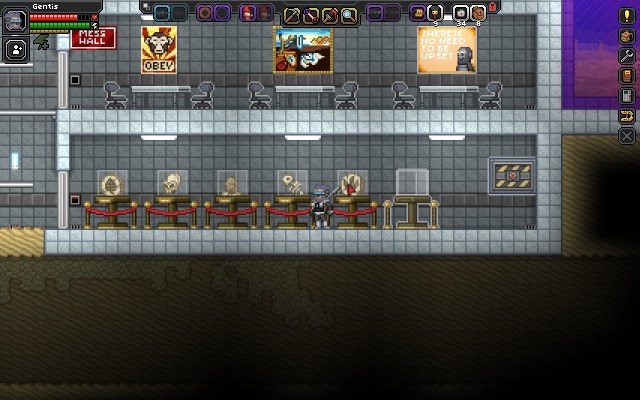
Create a character from a variety of different appearances and playable races. Source: A. J. Asplund
Starbound, considered by some a sort of spiritual successor to Terraria, is a 2D sandbox building game with a light overlay of adventure and exploration. When you start your game, an entire procedurally generated universe is created that you will explore. Ostensibly, you are one of the last surviving members of a galactic federation. You escape just as a terrible monster destroys the headquarters of the federation. All you have is a broken down ship and a matter manipulator, a tool that lets you construct and deconstruct matter. From there, you get to explore the wide open universe located on your hard drive.
There is a lot of procedurally generated galaxy to explore. Source: A. J. Asplund
There’s a story to follow, but there’s also a lot to do on your own. Go mining for resources. Build your own house. Or city. Construct an underground empire. Go searching for fossils. Capture strange creatures. Build a space station. Raid pirate ships. To a certain extent, Starbound is what you make of it. On my home server, I built a small colony on an ocean planet. Shopkeepers and soldiers lived in peace on the surface. Hidden in the main structure was an elevator leading deep down into the ocean below, where I had constructed a giant underwater farming colony, growing exotic plants from across the galaxy. Eventually, I added a museum to showcase all the fossils I had discovered in my adventures. Starbound is what you make of it.
Building your own structures is a big part of the game. Here’s my museum. Source: A. J. Asplund
I actually talked about Starbound twice: once, in Episode 122- It’s a Fake, where I first picked up the game but didn’t quite get it, and again in Episode 136 – Make it So, when I set up a Starbound server at home for some friends to play around with. It’s worth mentioning that the game continues to get updated, so there’s seems to always be something new around the corner.
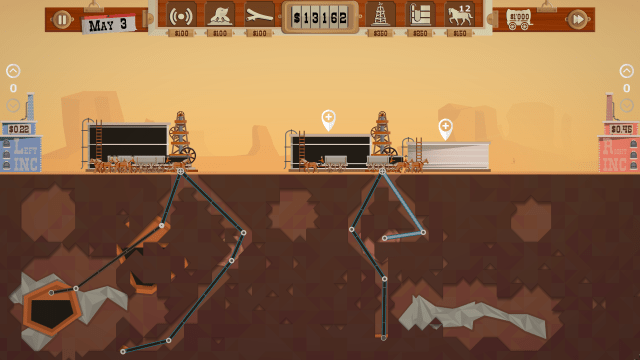
Turmoil, by Gamious, is a lighthearted simulation game set in 19th century North America. It’s about OIL. You play a young entrepreneur that starts into the oil drilling business. Each level focuses on a single plot of land, precious black gold buried somewhere underneath the surface. Through a combination of using sounders and effective drilling, you try your best to pull as much of the oil as you can to the surface, where your oil delivery men then haul it to sell. And you have exactly one year to do it. Of course, there are challenges. Sometimes, the market price for oil dips, so maybe it’s better to stockpile your oil. Or maybe the pocket of oil you found has gone dry and you need to dig deeper. As you continue through the game, things get complicated.
Drilling for oil never seemed this entertaining in the movies. Source: Gamious
Between levels, you go to town, where you have the opportunity to spend your money on all sorts of things. New technology. Improved sounders. Better drills. All the sorts of upgrades you need as things get more difficult. You also have to compete against three other oil tycoons, each trying to be the best oil tycoon around. And, like any game about rich oil tycoons trying to make it big, you also have the opportunity to buy and sell stock in each other’s oil companies. It may be that the easiest way to beat Ricardo is to buy out his oil company.
Fred the Factory guy wants to upgrade your drills and pipes. Source: Gamious
I first mentioned this game back in Episode 128 – His Curry Name. There have been a few minor tweaks and patches since then. But, perhaps the most important thing is that they’ve announced new DLC that is coming soon, sometime in the first quarter of 2018. Maybe it’s time you take a chance at being an oil tycoon.